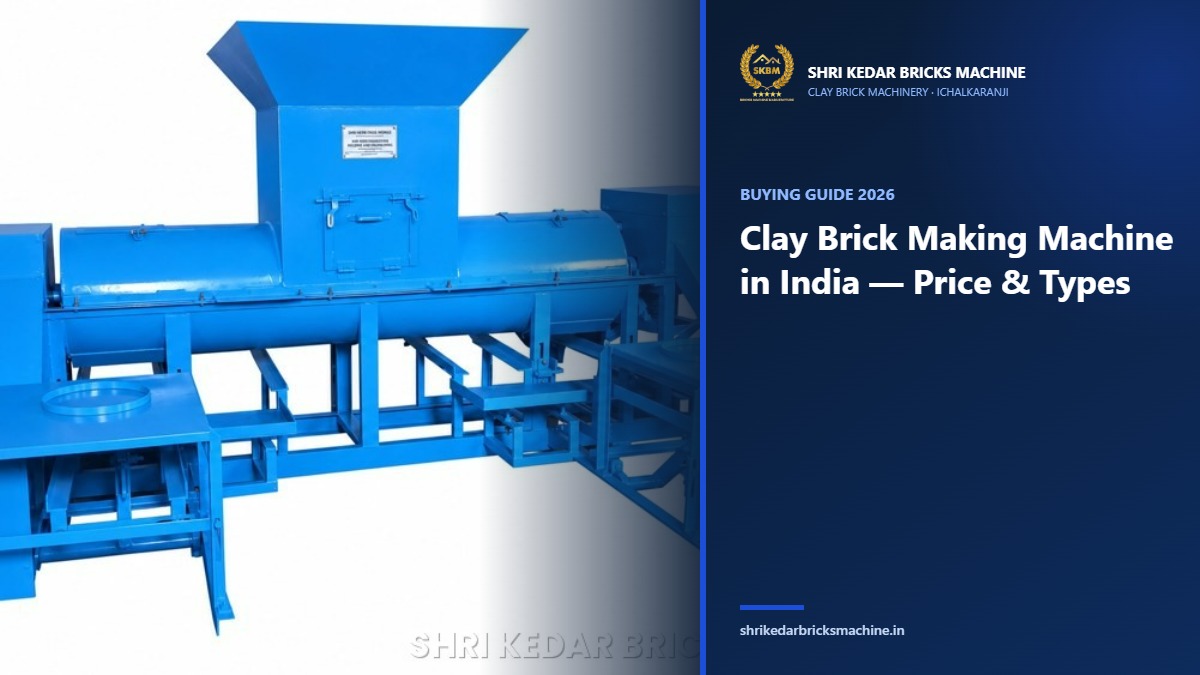
If you are planning to buy a clay brick making machine in India, you already know the market is crowded with options – manual machines, semi-automatic machines with 2 or 3 moulds, 2×2 machines, rotary machines, and a long list of price claims from different suppliers. Some quotes look too cheap to be true, others are shockingly expensive. So how do you know which machine is right for your production target, your budget and your location?
This guide answers every practical question: what each type of machine does, how many bricks you can realistically produce per day, what decides the clay brick making machine price in India, which accessories you actually need, and how to judge a manufacturer before you pay the advance. It is written from the point of view of a manufacturer – Shri Kedar Bricks Machine, based in Ichalkaranji, Kolhapur, Maharashtra, building brick machinery since 1973 – so you get the same advice our team gives on the phone, without sales pressure.
Bookmark this page. Every question below is answered in plain language, and every section links to the exact machines on our website so you can check specifications and request a quotation.
What is a clay brick making machine?
A clay brick making machine converts prepared clay (mixed with sand and water in the right proportion) into uniform, green bricks by pressing the mix into moulds. The green bricks are then dried and fired in a kiln to produce the final red brick. The machine replaces slow, inconsistent hand moulding with a repeatable pressing cycle, which gives you three benefits:
- Uniform size and quality – every brick comes out of the same mould, so buyers get consistent product and your rejection rate drops.
- Higher daily output – a machine produces more bricks per labour hour than hand moulding.
- Lower labour dependence – good machines are designed to run with unskilled operators, which matters a lot in districts where skilled moulders are hard to find.
A complete clay brick line usually has four parts: clay preparation (a clay mixing machine that kneads clay, sand and water), the moulding machine itself, drying space for the green bricks, and the kiln for firing. The moulding machine is the heart of this line – and the part this guide focuses on.
Types of clay brick making machines in India
Indian manufacturers broadly offer three categories. Understanding the differences is the first step to choosing correctly.
1. Manual clay brick machine
A manual machine is the simplest pressing unit. The operator fills the mould box with prepared clay, and the machine compresses it – powered by a tractor, a diesel engine or manual effort, depending on the design. SKBM manual machines are tractor or diesel operated and are designed to run with unskilled labour.
- Typical output: roughly 1,000–2,000 bricks per day for a small crew working a normal shift.
- Investment: the lowest of all categories – this is where most new units start.
- Power needs: minimal; tractor PTO or a small diesel engine is enough.
- Best for: entrepreneurs starting their first unit, sites with limited electricity, and villages where a tractor is already available.
The trade-off is output: a manual machine will not feed a large order book. But as a first machine, it teaches your team the full production cycle at the lowest possible risk.
2. Semi-automatic clay brick machine
Semi-automatic machines are the workhorses of the Indian brick industry. Clay feeding and pressing are mechanised, and the operator supervises the cycle instead of doing every step by hand. Output jumps several times compared to manual machines, brick quality becomes consistent, and one machine can run through a full shift without the fatigue problems of manual work.
Within this category, the mould configuration is the key specification. Each “mould” is one brick cavity per pressing cycle. More moulds per cycle means more bricks per hour – and a higher machine price. SKBM builds three configurations:
Semi-automatic 2×2 machine
The Semi Automatic 2×2 Brick Making Machine is a balanced configuration for units that want reliable daily production without moving to a large rotary plant. It suits owners who have steady demand from local builders and want a machine that runs all day with simple maintenance.
Semi-automatic 2 mould machine
The Semi Automatic 2 Mould Brick Making Machine produces two bricks per pressing cycle. It is the entry point of the semi-automatic range – easier to operate, quicker to learn, and economical for units stepping up from manual production.
Semi-automatic 3 mould machine
The Semi Automatic 3 Mould Brick Making Machine adds a third cavity per cycle, pushing output higher for the same shift length. Choose it when your order book is growing and you cannot afford a production bottleneck during peak season.
3. Rotary clay brick making machine
The Rotary Clay Brick Making Machine is designed for continuous, high-volume production. The mould table rotates, so filling, pressing and ejection happen in sequence without stopping the machine. This is the category for established factories that supply builders merchants, contractors or multiple markets and need every hour of the shift to count.
- Typical output: several times a semi-automatic machine; rotary plants in the Indian market are commonly quoted from a few thousand bricks per hour upward.
- Investment: the highest of the three categories.
- Best for: established units, cluster supply, and owners planning multi-kiln operation.
For a deeper comparison of mould formats, read our guide 2 Mould, 3 Mould or 2×2: Understanding Brick Machine Configurations.
Quick comparison
| Machine type | Typical output | Power option | Who it suits |
|---|---|---|---|
| Manual clay brick machine | ~1,000–2,000 bricks/day | Tractor / diesel engine | New units, small budgets |
| Semi-automatic (2 mould) | ~3,000–5,000 bricks/day | Tractor / diesel / motor | Growing units |
| Semi-automatic (3 mould) | ~4,000–7,000 bricks/day | Tractor / diesel / motor | Higher daily targets |
| Semi-automatic (2×2) | ~3,000–5,500 bricks/day | Tractor / diesel / motor | Balanced production |
| Rotary clay brick machine | Continuous, high volume | Motor / engine driven | Established factories |
How many bricks can you produce per day?
This is the most common question – and the most over-answered one. The honest answer: output depends on five factors together, not on the machine badge alone.
- Mould count per cycle – more cavities, more bricks per press.
- Cycle time – how fast the machine completes fill–press–eject. Semi-automatic machines typically run a few seconds per cycle; skill of the feeding crew matters.
- Shift length – 8 hours is standard; many units run 10–12 hours in peak season.
- Clay preparation – a properly mixed, consistent feed keeps the machine running; a lumpy mix causes stoppages. That is why we always discuss the clay mixer along with the main machine.
- Manpower – feeding, stacking and moving green bricks to the drying area. SKBM machines are designed so unskilled labour can do all of this after basic guidance.
A practical way to plan: work backwards from your sales target. If you need 60,000 bricks a week and can run 6 days, that is 10,000 bricks a day – which points you to a 3 mould semi-automatic machine or a rotary machine, not a manual unit. Share your target with our team and we will tell you honestly which configuration meets it.
What decides the clay brick making machine price in India?
Search the market and you will see quotes from ₹65,000 for basic hand-operated units to ₹20 lakh and above for large rotary plants. All of these can be genuine – for different machines. Here is what actually moves the price:
Mould configuration
The number of moulds per cycle directly changes the amount of steel, machining and pressing power in the machine. A 3 mould machine costs more than a 2 mould machine – and produces proportionally more.
Operation type: tractor, diesel or motor
SKBM machines are available in tractor-operated, diesel engine and motor-driven versions. The right choice depends on your site: a tractor you already own lowers the entry cost; a diesel engine gives independence from power supply; an electric motor suits sites with reliable power and can lower running cost per brick.
Build quality and steel
This is where cheap quotes differ from honest ones. Fabrication quality decides whether the machine runs for years of daily brick production or needs constant repairs. Ask any manufacturer what steel sections are used in the frame and press, and how the moulds are hardened. At SKBM, machines are fabricated in our own works in Ichalkaranji and our builds go back to 1973 – several of our earliest machines are still in production today.
Accessories and the complete line
The main machine is one part of the project. Budget for:
- A clay mixing machine (big) or regular clay mixer for clay preparation
- Drying space and stacking arrangements
- Kiln construction for firing
- Transportation, installation and operator guidance
When comparing quotes between suppliers, compare the complete setup – not just the machine. A lower machine price with no mixer, no guidance and no service support often costs more per brick over the first year.
So what is the price?
Because every unit has a different target, mould size and power requirement, we do not publish a single fixed price – and you should be careful of anyone who does without asking about your requirement. As market orientation: small manual units start in the tens of thousands, semi-automatic machines for serious daily production are typically in the low-to-mid lakhs depending on configuration, and rotary plants move into the multi-lakh range. The fastest way to a real number: WhatsApp us or call +91 74474 82323 with your daily target and location – you will get an exact quotation with delivery and installation details.
Clay preparation: the step most buyers underestimate
Every experienced brick manufacturer knows the truth: the machine only shapes the brick – the clay mix decides its strength. Clay dug straight from the pit contains stones, roots and dry lumps. If that goes into the moulds, you get weak bricks, air pockets and rejected batches.
That is why clay preparation comes first in every SKBM setup discussion. A big clay mixing machine kneads the clay with sand and water into a consistent, lump-free feed. For smaller units, the regular clay mixer handles the same job at a smaller scale. The principle: the mixing machine should match or exceed the output of your moulding machine, so the press never waits for clay.
The right water–sand ratio
- Clay should be plastic enough to hold the mould shape but not sticky enough to cling to the moulds.
- Sand content controls shrinkage during drying – too little sand and bricks crack as they dry.
- Water content changes with season; monsoon clay needs different treatment than summer clay.
- Your operator learns this balance within weeks – but the mixing machine makes it repeatable.
We cover this in detail in Clay Preparation Basics Before Brick Moulding.
Operating costs: tractor, diesel, motor and labour
The purchase price is only the beginning. The cost that decides your profit is the cost per brick – and it has three parts.
Power
- Tractor operation: if you already own a tractor, this is the cheapest route – no extra engine to buy, and the tractor stays useful for farm and transport work.
- Diesel engine: independent of the power grid; the right choice where electricity is unreliable or connection delays are long.
- Electric motor: lowest running cost per hour where power supply is dependable, and quiet enough for units closer to residential areas.
Labour
SKBM machines are deliberately designed for unskilled operators. One supervisor plus a small crew of loaders and stackers is enough to run a semi-automatic machine. In districts where skilled moulders command high wages – or simply are not available – this design decision saves money every single day.
Maintenance
Daily care is simple: keep the moulds clean, lubricate the points listed in the manual, check bolts and belts, and do not ignore unusual sounds. Periodic part replacement – bushes, pins, mould plates – is normal wear. What matters is getting spares fast. SKBM supplies spare parts support to customers across India, and because every machine is built in our own works, parts for our machines are always available.
Our Machine Maintenance guides cover the daily and monthly routines in detail.
How to choose the right machine: a decision checklist
Use this checklist before you talk to any manufacturer – including us. It will make the quotation conversation faster and protect you from buying the wrong machine.
1. Define your real daily target
Not the dream target – the target your current orders can absorb. A machine that produces more than you can sell ties up money; a machine that produces less creates a bottleneck within a year. Plan for the volume you can sell in year one, and choose a configuration you can expand around.
2. Check your power situation
Reliable electricity → motor-driven version makes sense. Weak or delayed power → tractor or diesel operation. Already owning a tractor → tractor PTO operation is very economical.
3. Check your clay
Good brick clay near your site is the foundation of the whole business. Get the clay tested locally if possible – clay with too much sand or too many stones needs different handling and possibly different mould sizes.
4. Count your labour
How many people can you realistically employ for the shift? Machines differ in the crew they need for feeding and stacking. Tell the manufacturer your crew plan – a good one will size the machine accordingly.
5. Ask these five questions to every supplier
- What steel sections are used in the frame and press?
- How are the mould plates hardened, and how long do they last?
- What is included in the quotation – mixer, installation, operator guidance?
- How fast can I get spare parts in my district?
- Can I speak to an existing customer running the same machine?
A manufacturer who answers these confidently – and puts the answers in writing with the quotation – is worth shortlisting. A manufacturer who dodges them is not, whatever the price.
6. Compare the complete package
- Machine price with the mould configuration you need
- Mixing machine capacity matched to the press
- Delivery charges to your site
- Installation and commissioning support
- Operator training for your crew
- Spare parts availability and pricing
Why brick manufacturers buy from Ichalkaranji and Kolhapur
The Ichalkaranji–Kolhapur belt of Maharashtra has been a machinery manufacturing hub for generations. For brick machinery specifically, the region offers something rare: foundries, fabrication workshops, machining and engineering talent within a small radius – which means machines are built, tested and serviced locally, and improvements reach production quickly.
Shri Kedar Bricks Machine has been part of this ecosystem since 1973. Three generations of machine building have gone into our current range – rotary machines, 2×2 machines, 2 mould machines, 3 mould machines and the complete clay preparation range.
What buying direct from SKBM gives you
- Direct manufacturer pricing – you buy from the works, not from a trader, so there is no middleman margin in your quotation.
- Builds proven since 1973 – our design philosophy is practical, serviceable machines for daily production, not experimental prototypes.
- Tractor, diesel and motor options for every model, matched to your site.
- Unskilled-labour-friendly design – your crew does not need prior machine experience.
- India-wide delivery and support – we coordinate transport, installation guidance and spare parts to your district.
- Direct conversation – you speak with the people who build the machines, not a call centre.
Customers across Maharashtra, Karnataka, Telangana, Madhya Pradesh and beyond run SKBM machines today. If you want references in your region before you decide, ask us – we will connect you with an owner running the machine you are considering.
Frequently asked questions
What is the price of a clay brick making machine in India in 2026?
It depends on type and configuration. As market orientation: basic manual units start in the tens of thousands of rupees, serious semi-automatic machines sit in the low-to-mid lakh range depending on moulds, and rotary plants are multi-lakh investments. The exact figure depends on moulds, power option and accessories. Contact us with your daily target for an exact quotation.
How many bricks does a semi-automatic machine make per day?
A 2 mould machine supports roughly 3,000–5,000 bricks a day on a normal shift, and a 3 mould machine roughly 4,000–7,000, depending on cycle speed, clay preparation and crew. Rotary machines produce continuous high volume for large factories. Tell us your shift plan and we will calculate the realistic figure for your configuration.
Which machine should a new unit buy first?
If your budget is limited and orders are small, start with a manual or a 2 mould semi-automatic machine and grow from there. If your order book already supports several thousand bricks a day, start with a 3 mould or 2×2 machine. Buying slightly ahead of your confirmed demand is sensible; buying far ahead of it is not.
Is a tractor-operated machine better than a diesel engine machine?
Neither is universally better. Tractor operation is the most economical if you already own a tractor and it is available during production hours. A dedicated diesel engine gives you independence from the grid and from tractor availability. Motor-driven machines suit sites with dependable electricity and offer the lowest running cost per hour.
Do I need skilled workers to run a brick making machine?
No. SKBM machines are designed so that unskilled labour can run them after basic guidance from our team. Most units employ local workers for feeding, stacking and kiln work, with one person supervising the machine.
What maintenance does a brick making machine need?
Daily: cleaning moulds, lubrication points, and checking fasteners. Weekly: belt tension and wear inspection. Periodically: replacement of bushes, pins and mould plates as they wear – normal for any pressing machinery. SKBM supplies spare parts across India, and our machines are built so that routine part replacement does not require special tools.
Do you deliver and install across India?
Yes. We coordinate transport from our works in Ichalkaranji, Kolhapur to your site, guide installation, and provide operator guidance so your crew starts correctly. Support continues after delivery – spare parts and service guidance are always a phone call away.
Can the machine make different brick sizes?
Moulds define the brick size. Standard modular sizes are most common, and mould plates can be made to your required size within practical limits. Discuss your market’s brick size with us while ordering so the moulds match your buyers’ expectations.
Final word: buy the machine that matches your market
The best clay brick making machine is not the most expensive one or the cheapest one – it is the one whose daily output matches your orders, whose power option matches your site, and whose manufacturer answers the phone after delivery. Get those three things right and the machine pays for itself season after season.
Shri Kedar Bricks Machine has helped brick manufacturers make exactly this decision since 1973. If you want a straight answer about which machine fits your requirement, call +91 74474 82323 / +91 75070 12323, WhatsApp us, or explore the full range on our Products page.